

Episode Summary:
Episode thirteen of the Spiritual Dance Podcast features special guest Jessica Warchal-King, Director of JCWK Dance Lab in Reading, PA. This discussion covers a wide variety of topics concerning spirituality and dance as Jessica shares her story of growth and evolution in her professional endeavors and spiritual journey.
Speaker Information:
Jessica C. Warchal-King, MFA, described as a “post mod(ern) ballerina” by the Philadelphia Inquirer, is founder and director of JCWK Dance Lab, a Reading- based contemporary dance company. The organization supports her artistic & creative research utilizing physical dance practice, performance and education to create joy, connection and wellness through kinesthetic stories. She is Artist in Residence in Dance at Alvernia and has been on faculty at Drexel and Widener Universities. She was a senior dance artist with Kun-Yang Lin/Dancers (KYL/D) & Nora Gibson Contemporary Ballet. Jessica earned her MFA in performance and choreography from Temple University. She holds a BA in Dance and Anthropology from Muhlenberg College.
Connect with Jessica through these Links:
- https://jcwkdancelab.org/
- https://jcwarchalking.blogspot.com/
- Socials - @jcwkdancelab
- https://www.linkedin.com/in/jessica-warchal-king-12106863
- https://www.bctv.org/program/greater-reading-area-dance-exchange/
Episode Transcript:
INTRO: Welcome to the Spiritual Dance Podcast. A virtual space for creative souls discovering how to move in sync with the rhythm of spirit. I’m your host Carla White Crowe, also known as The Dancing Oracle. In this podcast, I share openly about my journey of weaving together my two primary passions - spirituality and dance. My intention is to encourage and inspire spiritual seekers in pursuit of a more embodied form of spirituality as well as provide insight and tools for those seeking to expand their creative edges in service to the world of spirit.
CARLA: All right. Hello, everyone, and welcome to the Spiritual Dance Podcast. So this is a very special episode for me. I have never had a guest on this show before, and I'm very excited about my first guest on the show. So our guest today is Jessica King. She is the director of Jesse K Dance Lab in Redding, PA. That's correct. Right?
JESSICA: Yeah
CARLA: Yeah, we met through mutual friends. Autumn, she has been talking about you for many, many years, and so I've been following your work online for many years and very intrigued. It seems like we have some similar interests and overlapping stories, so I'm super excited to talk with you today and hear your story. Um, let's just jump in right to the beginning. If that sounds good for you, I'd love to hear. When you first knew that you wanted to dance. Like, what got you into dance? And where did that journey take you?
JESSICA: Sure. Um, my mom started me put me in tights when I was three, like many little girls. And I say that was kind of the end of it, but I absolutely. Here's the story of when I knew you. Okay. Um, it was Friday. I was in fourth grade, it was career day, and we were supposed to draw what we wanted to be when we grew up. I was ten. I didn't know. You know, I'm not so sure. I still know what I want to be when I grow up. Um, so my best friend Laura, her parents were lawyers. She was going to be a lawyer. So she drew a desk, and I drew a desk, and she drew some books, and I was like, okay, I'll draw books, too. You know, her parents are nice. I like Laura, um, and then the next day and then. Yeah, that was that. We turned in the papers and career day was over. Okay. I don't remember what exactly happened the next day, but something happened. I was a member of the junior company at the ballet studio that was local, and something happened. Either we had a performance or pointe shoes or something. And I went back to Mrs. Powers on Monday and I cried at her desk and I said, Mrs. Powers, I lied. I'm so sorry I lied on my career day paper. I don't want to be a lawyer. I want to be a dancer. Can I please have my paper back? I need to draw a dancer. And she was like, okay, all right, here you go. Silly fourth grade girl who's crying. Don't cry. Like, you know, this isn't a big deal. I was like, no, I lied, I lied, and, um, you know, when we talk about dance and spirituality, it was such a a deep, deep, profound moment of this is who I am and this is what I need to be, and this is my calling at ten. Um, and so, yeah, that was that was the moment that was pretty was one of the major catalysts of of knowing. Yeah. I had another moment when I was 16 and I was attending the Pennsylvania Governor's School for the Arts. And at that point in time, my body had changed a little bit. And I was told you, you're not really going to be a ballerina. Um, and you're too smart to be a dancer, which I adamantly disagree with. But you could be a choreographer. Or maybe you should try med school. Mm. Okay. Um, talk about lots of information coming at you from all different angles. But I was attending the Pennsylvania Governor's School in the summer, and I sat down with my advisor who said, you can absolutely be a dancer, you can be an artist. You can make this part of your life for the rest of your life. And it was the first time that somebody had said that to me at that point, in that context, um, and believed in me that I could do it. Yeah. So those were two moments that were incredibly powerful and impactful and grounding that. I was allowed, I was given permission in a sense that I could follow an artistic path.
CARLA: Yeah, I love that you like there was something in you after you wrote or drew the books that was just like, no, that's not who I am. Like, there's a strong voice in there, and you paid attention and you followed that. That's really beautiful.
JESSICA: Thank you. Yes. That voice is very, very strong sometimes to, uh, you know, to my detriment sometimes because I'm very stubborn and that, like, I am an artist and art can change the world and. Yeah. And we need we need creation. It's hard. It's hard to, um, toe that line sometimes. Yeah.
CARLA: For sure. So where? Tell me about, like, your training. Like, where did that journey take you?
JESSICA: Um, I grew up, like I said, as a in a small, pre-professional ballet company. Okay. Uh, trained at the Pennsylvania Governor School for the Arts when I was in high school. That was the summer program. I went to Muhlenberg College for dance and anthropology. Uh, it was a double major of mine. And we primarily did ballet and modern, um, and some composition, some jazz. There were opportunities for tap and hip hop, um, at Muhlenberg as well. Um. And then I spent a couple of years working professionally and decided that I wanted to be intellectually stimulated, creatively stimulated, and physically stimulated in the way that I'd seen that and the ways that had been modeled for me were as a professor at an institution. And so I went to temple and got my MFA in performance and choreography from temple. And when I was at temple, I met Quinn Young Lin and Nora Gibson, who were two mentors in the Philadelphia area who took me under their wing. And I spent about a decade with, uh, young, working with them as a dancer and administratively and then with the Nora Gibson's Contemporary Ballet Company. So I was able to continue on with the with the pointe shoes for a couple of years. Um, my little ballet journey. But it was really Young's work that. Connected me with dance as a spiritual practice, um, as when I was. In. It was something that I was deeply interested in. I was studying yoga and Hinduism as part of my graduate work as well, because I love symbolism. That was one of the things that brought me into anthropology, was looking at the way that people tell stories, and the way that people create meaning through symbols. And the body was the way that I was storytelling and creating meaning and using symbols. And so the the dance and the anthropology and those components made a lot of sense to me. And then thinking about the way that we interact with spirituality and the different symbols that we create, or that we look at and develop as communities to bring meaning into our worlds, and sometimes they're different for everyone, right? Like, so a cardinal might be is deeply spiritual to me, but it might not be to somebody else. Um, and so I really appreciate in your book where you talk about looking to nature and looking to the interconnectedness of the worlds that are around us as a part of spirituality. So that's a that's a far jump ahead. Um, when I was in my master's program, I was studying yoga as a through, excuse me, yoga as a religion and studied further Hinduism, uh, with the religion professor who was primarily working in yoga and Hinduism. And as part of my readings, I read that the in Hinduism, one of the branches looks at the body as a microcosm of the universe. And that blew my mind to think about how sacred we value the universe. And when we look up to the night sky and we're in awe of the night sky and all of the wonders of of the universe and the mystery and the mastery. And our bodies are that sacred. If our bodies are microcosms, then by default our bodies are also as sacred, and we deserve to respect in all our bodies as much as we do the universe. Um, and growing up Catholic. So we talked about let's dive into that a little bit. Um, I grew up Catholic, which the body was very separate from spirituality and almost, um. Evil or the site of, of evil and bad things. And that was so I deeply wrestled with that because it was my body was the way I was creating symbols. My body was the way I was telling stories. My body was the way that I was understanding and interacting with the world. Um, how could it be evil? How could I be evil? And was I was I bad or not good? Or, you know, all all of the, the language, the negative language that we feed ourselves from ideas of. Social, social, whatever. But the stories that were told by other people that may or may not be true. Um, it was the first time that I was able to reconcile when I read this passage. The body is a microcosm of the universe. It was the first time that I was able to reconcile that. Maybe there is a way to think of my body as sacred. That is different than the way that I was brought up in the Western Catholic tradition. So it was really, um, profound moment for me to feel validated and feel empowered and feel like I had permission to be an artist in the way that I wanted to be an artist, um, and to use my body to glorify and to to be glorified and to expand the stories of the universe and create, um, create an opportunity for other people to understand how their bodies are sacred as well. So that moment, um, that moment in grad school has sort of been pivotal for me to and really shot me on this trajectory of social justice and the work that I'm doing because all of our bodies are sacred. If our body, if the body is sacred, or if the body is a microcosm of the universe, therefore our body is as sacred as the universe. Therefore, we need to respect and treat and honor our bodies. Um. And dance allows us to do that? Yes. Yeah. I think, um, dance allows us to know all of our bodies because it is so multi-dimensional. We have to empathize with ourselves and empathize with the character. We have to understand our intellectual body and the anatomy. We have to understand our physical body and the way that we exist in space. We have to know our social body and the way that we existed with other people. We have to know our spiritual body and and our emotional body, and the way that we, um, use our imagination to connect with, with the greater cosmos of which we are a microcosm. So, um, that's a lot. And we're just we're, um, that's just jumping. Jumping a little bit out of grad school.
CARLA: No. Yeah. It would help, I think, if we. So what would you say spirituality means to you? Like, does that make sense?
JESSICA: Yeah. Um, to me, spirituality is an understanding that we are interconnected entities and the impacts that we create. Has a ripple effect. Um, so the energy that I put out in the world is going to impact the people around me. And through that connection, that interpersonal connection, that inter species connection, that inter. Realm connection. We have the opportunity to create balance and create hope and create peace and and create love. Um, and so. For me, spirituality is really understanding the ways that I am interconnected with my environments and with the world that I might not know exists. Um, because I only know what I know. And this in the places where I am and what I, what I am. Um, but understanding that I am part of something greater and that my actions have an impact on things that are greater than me.
CARLA: Beautiful. Do you have a specific path that you follow or specific practices that you do to engage with that?
JESSICA: Um. I haven't followed anything organized in a in a long time. Uh, I've done a lot of intellectual study. Um, both from a academic religious perspective and from an anthropological perspective. Um, in terms of Buddhism and Taoism and Hinduism, but I haven't I don't subscribe to anything that is organized, um, or practiced. And I think yoga might be the closest to dance as a spiritual practice. Understanding that movement is a way to connect with the brain and the body, and to calm the mind and to, um, to deepen into the self so that the self can be open to all of these other experiences. But I haven't. No, I don't subscribe to anything that's organized.
CARLA: do you? Go ahead. Go ahead.
JESSICA: No, I was just saying I am really interested in the connection between. And you talk about this a lot in your book. Um, shout out for Carla's book Dance Divination. Um, the connection between the body and nature. And a couple of years ago, I came upon this scholarly academic term called bio feminism that that relates to, um, looking at. Nature as being equal to people, um, as the way that feminism sort of looks at the, the whole of a community instead of a hierarchy of a community. And I'm like, I don't know, your, uh, listeners aren't gonna be able to see this, but I'm, like, circling my hands along a flat plane as opposed to raising them from high to low to a low level. Um, so my understanding, at least of feminism, is that we are sort of on this circular, even plane, but we each have different gifts that we offer as opposed to a hierarchical system. And looking at bio feminism is understanding the natural world as part of that equal playing field, which we are all part of and interconnected through. So my creative work has been inspired by that idea of integrating with, with the natural world and with the science of the natural world and understanding, um, how we are not separate from the natural world.
CARLA: Yeah, I think that's what really intrigued me and drew me to look more into your work was, um, I remember Autumn telling me about, like you did. We are stardust and like, the work you've done just with, like, soil and things like that. And nature. That was such a when I left the church. That was my church. Nature was my church. And I looked for the divine in nature. And that that has been my primary like spiritual journey over the last five years. And and weaving movement into nature has just been fascinating. So it was cool to find somebody else who was also, you know, on that same in that same kind of a realm, too.
JESSICA: Yeah. So much sense to me. And even now, as we're talking about, um, or climate change is becoming more prevalent in our world, the way that the butterfly effect, when one thing happens in one part of the world, it has an impact on the other. I don't think that our human energies are are that much different. Um, so. Yeah. It's exciting.
CARLA: Very much. Do you? When you grew up Catholic? Did I hear that right?
JESSICA: Yes.
CARLA: Were you, like, in church every week? Was that a regular part of your growing up?
JESSICA: Yes. Um, in church every week. I was an altar girl, so I had. I was one of the first, like. This is another moment of pride is that I was one of the first altar girls accepted into our church situation. And it was shortly after that. Altar girls, it was okay for girls to be a part of, um, beyond the altar. Yeah, it was, it was. That was another fourth grade. My fourth grade was a big year.
CARLA: Wow.
JESSICA: Um, yes. And then I, I was confirmed when I was in eighth grade. Um, and the one of the ironic things, you know, there are no accidents. Um, I currently teach at a Franciscan institution, which is a Franciscan being a derivative of the Catholic monks. Um, and it was founded by the Bernardine sisters, who were. From under the nuns underneath the umbrella of the Franciscan monks. Um, and one of. So the Saint Francis of Assisi is the patron saint of the institution. And so we we often talk about we the campus community often talk about his relationship to nature and his relationship to understanding the unseen God in nature and understanding the interconnectedness of who we are as people with nature, but also the different ways that we exist in the world, our intellectual selves, our emotional selves, um, our spiritual selves, and not knowing that a million years later I would be working at a Franciscan institution. I chose my confirmation name, Claire, um, after a family member who had passed and was very dear to me, and also somebody that I aspire to be like, because she was so kind and she was very inclusive in the way that she wanted to make people feel. Um, something I deeply remember about her was that she always made people feel welcome and warm. And I wanted to be like that. So I took her name for confirmation. And Claire is the female counterpart to Frances. Um, and so there are often notes around campus that will say, be like Claire or what will Claire do? In addition to what would Francis do? And Claire also subscribe to ideas of, um, harmony and peacemaking and collegiality. And so, um, right. There are no accidents, but it is a little fun and ironic at times for me to think about that.
CARLA: Um, but you didn't dance in the Catholic Church. There wasn't dancing in your particular Catholic community.
JESSICA: There was not. There were moments where I was asked to be a part of a special ceremony. I remember dancing once on the altar, for I think it was May day to celebrate Mary, but it was not a part of the regular practice, and there was not an organized group of people who were dancing in the church or who were. Looking for that to be a part of their religious practice.
CARLA: Okay. Were you ever a part? I mean, other than the the Buddhist community. Were you ever a part of a, like a liturgical dance situation or like a spiritual dance situation in a formal, like, organized way?
JESSICA: No. And this is the thing that I've been thinking a lot about and that I have thought a lot about. I was a part of several Christian, uh, bands.
CARLA: Okay.
JESSICA: Um, so I sang and I used my physicality as a form of worship, but dance as a worship practice in my communities was never something that was accepted, um, or appreciated or encouraged, I think, quite frankly. So there were quite a few of us who were when I was in college, um, I was a part of a band that was sang primarily at the Lutheran ceremonies, but it was a bunch of different Christian artists who were interested in. Celebrating and praising and worshiping in this particular way, using our bodies. But the medium that was available to us was through through music.
CARLA: Was there a specific moment for you that you remember, either like the first 1 or 1 that stands out where you, um, had this like, aha, moment of spirituality and dance coming together for you? Where did that intersect for you?
JESSICA: There was a moment where I felt I was given permission to be a dancer, and it wasn't a. So I'll tell you about that moment. Um, and then I will reference again that moment where I was reading the book of for my Hinduism class in grad school, where the the body is, is a microcosm of, of the universe. Um, that was really, again, profound and gave me permission to use my body as a form of spirituality and understand that my body is a gift and I can use the gift for, for service. Um, and so much of. The way that I was taught about spirituality was service. Um, you know, what are your time, your talent and your treasures, right? So. So through service, I could give up my time. Um, my my treasure wasn't financial, but my treasure was the the leadership that I was able to create through dance and the community that I was able to build through dance. And the joy that I was able to create. When people are moving their bodies and they've got all those, you know, heavy hormones firing and, yeah, breaking down those barriers of of taking risks when those happy hormones are firing. Um, but when I was in high school, shortly after high school, I attended a Steubenville retreat, um, which is another Franciscan retreat. Um, and there is a lot of singing and a lot of three days of intense, um, community and and worship and. There was a moment that I had there where I was. Also, I felt I was allowed to be a dancer and a dance artist, and that it was a path that was laid out for me. Um, and I just needed to trust and follow that. And it wasn't a movement experience at all. It was a still prayer, meditative moment. Um, but it was a lightning rod in my, my mind and in my heart that this was a very like a centering. Like I said, lightning rod centering, grounding moment of, yeah, this is who you are. And it's and it's okay. And I accept that and it's not going to be easy. Um, but yeah, this is who you are.
CARLA: Right, right. How was your experience in Catholicism different from the Buddhism company? Or the Buddhist company? Is that how you.
JESSICA: So. Yeah. Kyung. Um Kyung does have a Buddhist tendency to his work, but it is not. It's more of a secular, contemporary dance company with, um, spiritual components. And he uses a lot of breath work. And the mission is to showcase a diversity of people on stage, um, and diverse voices and the like. I said, the breathwork, the practices, the physical practices of, um, Asian cultures that practice Buddhism, we were we practiced those we they were implemented into the contemporary dance choreography as much as, um, ballet or other Western modalities were incorporated as well. So it's been called spiritual. Um, yeah. And it does have a, like I said, a Buddhist, a Buddhist tendency, but it was not specifically a Buddhist dance practice.
CARLA: Okay, okay. I'd really love to go and watch some of those. I'm really curious about that.
JESSICA: Yeah, it's it was a really, really beautiful and beautiful learning experience. And we did have temple monks come to teach us, um, and we did have martial artists come to teach us. And we took master classes in a variety of different movement forms, which, again, was really fascinating to me to see the body being lifted up as a temple of spirituality. Whereas in Catholicism the body needed to be separate. And the body, the body is the thing that dies. The body is the thing that is evil. The body is the thing that commits sin. Um, whereas and so it was like, oh, my body is terrible. You know, combine that with all of the the messages that young girls receive from the media and all of that.
CARLA: Um, I would love to hear how you reconciled that. I know that I've talked about it in my book and on my podcast, but but I'd love to hear your journey of how you reconciled that, you know, with yourself, your identity and your spirituality currently.
JESSICA: Sure. I don't know that I have fully.
CARLA: Okay. That's okay.
JESSICA: Yeah. No, I think I think it's a constant conversation with my younger self.
CARLA: Yeah.
JESSICA: Acknowledging that I had been trained, I had been taught and using that language. This was the way that I was taught and questioning. Is that true? Are the teachings true? Were they true then? Um. Are they true now? Are they true to the person who I am and the person who I want to be? And I also insane? Who is the person that I want to be? I, I also hear who is the person I'm being called to be and is the person I'm being called to be. Do they believe in the things that I was taught? And so it's like it's a big it's a big sort of boardroom of conversations and unpacking and. Right. Um, and. Also acknowledging that the ways that, that we were taught when we were younger. Don't necessarily apply now. And our culture was a little bit different and expectations were a little bit different. And we have to let those things fade away and say goodbye and let them go with love. Thank you for your time. But you you don't. You're not valid anymore. Um. And thank you for the ways that you informed who I am now. But I don't need you anymore. And having those conversations with with my 16 year old self who is still very present in myself now. It's challenging at times, and also to say that that existed at a time, it served a purpose and that purpose is no longer valid. Um, and it's time for me to again say goodbye with love and thank you. And I need to let you go so that I can become the next iteration of myself. Um. And to bring back nature. It was in a yoga class once for this that the teacher said, look at the trees. Um, every year the trees shed their leaves and they let go of what they don't need anymore. And that was the moment where I was like, oh God, boy, you don't need Jessica. It's okay, it's okay, it's okay to shed. It's okay to crack and break and let things get ugly or disfigured because the trees are beautiful even when they're empty and they're, um. Yeah, very, very vulnerable in the winter time.
CARLA: Yeah. Yeah. That's beautiful. Yeah. Do you have. So for you dance. Are you mostly in a choreographer role right now or are you still actively performing a lot?
JESSICA: I am, yeah, not ready to get off the stage yet.
CARLA: I love that, love that. That's great. Have you. Do you. So where when you think about dance in your life, would you say, like for me, I've had a lot of spiritual experiences on stage while performing, but I feel like my most profound moments are either dancing in nature or sometimes in the actual choreography process when I'm by myself, like, that's when I feel and I'm playing and moving with spirit. You know, just me and spirit together. That's what feeds me. Is there a particular way of. You know, dance in your life, how dance works in your life, where you feel more connected to spirit than others.
JESSICA: I have to agree with you that, um, those moments of improvisation where you set an intention and then listen to the body and the pathways that are created from that intention and, and stop trying to. I'm tapping my brain right now or tapping my head right now, but stop, stop. Um, working from the the physical brain space of patterns, firing and listening to the pathways that the body wants to create is really powerful. Um, I also find, strangely enough, the practices of my childhood. Sometimes it's very grounding just to go back and do a ballet bar.
CARLA: Yes. Yes.
JESSICA: Re-enter into that rotation of first position and those demi plies and recognize the articulation. There's something, um, about the simplicity and the discipline that. I find very grounding. Sometimes. Sometimes it drives me nuts. But sometimes that that recognition of. I don't have to think about this. I can just go through the motions of flying and connecting my upper body, my lower body, and extending my foot through the tornado, or letting the jam occur and using that sort of like the the postures are preparation for the actual practice of yoga. That the ballet bar is a is a warming up of the body as a grounding practice so that everything is, um, the body and the brain space are sort of calmed down and warmed up to receive the information that will be transmitted.
CARLA: Yeah. Yeah. Um, I think there's it's like a ritual, like. Yeah, I think about bar specifically. I think it feels like a ritual to me. And there's something so centering and grounding in that, just like you said. Yeah. Ritual can be a powerful spiritual tool. So that is. That's really cool. I would love to know where. Like, where do you see yourself going professionally? Where do you see your journey taking you in the next five years?
JESSICA: Oh, that's a great question because I feel like I've just sort of completed a cycle of, um, goal setting and understanding. And now I'm like, okay, so what happens? What happens next? What happens now? Um, and so the challenge, I think, is being vulnerable and being open to. Where I will be placed next. Um. Over the past five. Yeah. You said five years earlier and I was like, yeah, a lot of things happen. There's a cycle there. Um, yeah. But in 2019, I had a home season in Berks County, and it was the first time I had been able to produce my own work in Berks County. Um, when I was in the Redding area, when I was growing up in Redding, I was told that if I wanted to be a professional artist, I would need to leave and a professional dance artist. There's an awesome music scene here. Yeah, but dance? Not so much. Um, and so I was like, all right, peace out, friends. See you later. And then as I grew up and grew older and more established in my professional career, I was being commissioned to do creative placemaking work and community building through dance, um, in the counties around Berks County, which is where Redding is situated. And I kept saying to myself, what if? What could I go home like, could I, could I create? Um, a space for that 16 year old dancer who was told you have to leave. Can I can I do that? And so 2019 was the first time that I was able to I was invited to present an evening length work, um, in reading. And then the pandemic happened. So it was a place where we again grounded and found ourselves. And I really looked at what was around in the community and who was dancing and how were they dancing. And so there is a lot of social dance in Berks County. There's a lot of there's line dancing, there's salsa dancing, there's a chat, there's, um, contra dancing. There's there are a lot of dance related experiences, but there isn't a professional dance community in, in Berks County. And so I wanted to really figure out if it was possible for a 16 year old person who was growing up to figure out a way to have a career in, in the movement arts, um, and not have to leave. And so I'm still investigating that. Uh, one of the ways that I'm investigating that is looking at arts and health and the arts and health movement that's becoming more popular right now. Um, I am trained in the dance for Parkinson's method. And we've developed we we Dance lab, have developed classes for people with other movement challenges and other age groups based on the dance for Parkinson's model, which was developed by Marc Morris, and also the Brain Dance Brain compatible Dance Education, which was developed by Anne Green Gilbert out of Seattle. So those are, uh. Yeah. Looking at the science a little bit is one way that I've been able to argue for advance in an area that is a little bit resistant to accept the body as a vehicle for positive social change, a vehicle for spirituality, a vehicle that is sacred.
CARLA: Yeah. Can you talk a little bit more? I know I read that in some of your notes. Um, talk a little bit more about dance for wellness, what that looks like and the work you're doing with that.
JESSICA: Thank you so much. Um, so it began as a dance for Parkinson's class at a local hospital, and we were at the rehab center, and music was happening. Laughter was happening, and we were getting people coming by and saying, I don't identify as having Parkinson's, but this seems fun. Absolutely. Well, then we'll change the name. We're going to be inclusive. Like what? It's not a big deal to change a name. Um, I'm more interested in getting people dancing because, again, the happy hormones are firing in the brain, and, uh, we I teach a class in creativity, and I try to bring in neuroscience to my students because a lot of them are healthcare science people. And we. Something that we learned when we're playing. We only need to repeat 30 times, whereas if we're learning it through rote memorization or in a in a boring, boring way, um, we have to repeat 400 times for new neural pathways to be created. And so through dancing, we are creating so many different neural pathways, and we're creating social connections. And um, like I said, when those happy when our bodies are moving and we're working our brains multimodality, so our aural brain is engaged and our creative brain is engaged and our physical brain is engaged, and and it's that, that imagination, that creativity that I love bringing out of and teaching the artistry of dance, because that is part of what's so unique about each individual is the way that they create and use their imagination to interact with the world around them. So something that I love doing is asking people who let me back up a little bit, um, I teach a class that is primarily seated for older adults who have a lot of movement challenges in a senior living community. And one of the things that I do is we will do ballet. But I tell them a little bit of the history of ballet and how it was developed, in the words of Louis the 14th. And, um, so then I asked them to be royals, and I asked them to make their crowns. And I say, you can make your use your hands to put your hands on top of your head and make your crown, and you can make your crown whatever you want. And so it's really neat to see some of them, like use one hand and make little tiaras, or make these giant like, antler like spikes with their fingers. And having fun with it because of course, it's silly to put a crown on your head, but they also sit up straighter. So there's this connection between their their brain and their spine and their tail and, uh, their core and, um, and they laugh about it. And then I ask them to describe you use your imagination. And they don't tell me what colour is your crown or what kind of jewels do you have on your crown? And then then they light up and they see. They see not just with their eyes, but they see with their imagination that this is this could be real. That connection with, um, with the world that we can't necessarily see with our eyes in front of us, but we can feel and we can interact it and again, interconnect with, um, so it's a little, maybe a little bit more secular way of thinking about spirituality, but being able to transport oneself through movement into a realm of, of joy and happiness. So that's what the class is. And we do, um. I do bring a couple of different genres and talk about the dance history and a little bit of the anatomy, and sometimes they'll say, hey, I do something like this in physical therapy and I'll be like, we're dancing because I it's that brain switch for them to not think about again, the route, the rote movement. And this is I'm doing this because it's good for me. Of course it's good for you. But it also it's good for you because it's good for your imagination. It's good for your connection. It's good for all of the different ways that we engage as complete whole beings. Um, and so being able to bring that to seniors and people who have been told, again, right or wrong, no judgment on why the story was told, but told for whatever reason that your body can't seem to use the imagination so that your body can move in a specific way or or be a fool being. Is is really beautiful to me, and empowering people to understand that their bodies are sacred, even if their bodies have a different type of story. Yes. And they bring in biodiversity again, and this is the nature science part. And like nature would be so boring if we only had butterflies. They're so beautiful. But like that just. And then we went and have flowers and then we went and have food and then like all the different ways that biodiversity is so important. And so that's, that is also true in our human experience. We need diversity in, in our thoughts and in our movements and in our, um, health pattern. We need that biodiversity, just like the natural world needs biodiversity to coexist and thrive. We need diversity in our human experiences in order to coexist and thrive and continue to grow.
CARLA: I love that you're doing this work. My grandmother had Alzheimer's, and so I yeah, it just makes my heart very happy to see this didn't really exist that I knew of. Like it wasn't on my radar back then. But I know that it's growing and that's really cool.
JESSICA: Thank you. Yeah, it is exciting to see all of the research that's being done on dance. Um, dance, the science of dance, the signs of dance, and how we can use the science of dance to advocate for the artistic practices of dance. Because. The artistry and the spirituality of the artistry. Feeds the science and feeds the physicality and feeds the neurons and the. Yeah, all of the the hard sciences that seem to get a little bit more attention than. Yeah, the, the artistic importance of it.
CARLA: Mhm. So let's jump back real quick to your, um, professional and creative endeavors with dance. Is there a particular work or project that you've done that you feel most proud of?
JESSICA: Um, since we've been coming out of the pandemic, uh, we, JCWK Dance Lab, have created three evening length works, which I'm equally proud of each of them, because the process of getting to them has been different and it's been a building process. So the first 2003, right after the pandemic, um, process was. That was the We Are Stardust project. Um, the piece itself was called Dark Adaptation and a little bit of a backstory when we were all in Pandemic World. Um, I was I spent a lot of time looking at the moon and looking at the stars as a lot of people did, and appreciating that. And I saw a Netflix documentary where an astronomer said, we are all stardust. And I was like, oh, it was another body as the microcosm of the universe moment for me. Like, what if we. Right? Because we were in a pandemic and everybody was there was a lot of animosity and there there still is. But, um, what if we treated each other with the awe and wonder that we are all looking up at the stars? And so that became a multi-year process of, again, looking at the body as sacred and understanding that movement is sacred and the way that we are connected is sacred. Um, and so I worked there was a composer who was also doing the. The same sort of similar work in looking at the stars and translating it that majesty to his medium. And because the universe speaks to us in the way that the universe speaks to us. I found him on LinkedIn, and I didn't know he was doing work because his work just popped up on my feet and I was like, oh, this is exciting. So we connected and, um, ultimately created dark adaptation from from that collaboration that was 2003 or 2023, excuse me. Numbers. Um, then 2024, our project was regeneration. We were looking at. So we moved from the stars to the sky, just like meteorites do. And I wanted to look at what was happening in our community. Um, and so the Rodale Institute, which is a leader in soil regeneration, is right up the road. Um, and it was and I was just spent a lot of time looking at their research and the importance of, again, this interconnectedness using what we have growing with what we have, um, pulling strengths from each other to build and rebuild and move forward, um, move forward better, whatever better means. But move forward better as an interconnected community. Um, and then looking at for me, I started seeing. Different opportunities for collaboration inside of our people community. Not just the biodiversity community, but the people community and brought in. That was a fun project because we brought in three local composers who created original music. We brought in a visual, a local visual artist who was also working on environmental themes. Um, we had seven, seven cast members of various ages involved in the performance, and it was a big community project that again, looking at um, bodies being sacred and different ways that we can we can demonstrate that whether it's visual art or use, you know, use the body to create visual art, use the body to create music, use the body to create dance, use the body to have conversations. Um, and that was really fun for me because I wanted to allow people who were in the audience to find a way that they could insert themselves into the work. So you don't like dance? Maybe you can check out the art and ignore the dance on the stage, or close your eyes and listen to the music like there are so many different layers of. Integration that people, audience members, could find a way to say, oh, I can I can be a part of this conversation because I'm interested in this aspect of the ways that things are being brought together. Yeah. Oh, and then we just closed, um, a series called the piece that we created that we created was called The Grief Project. And we we looked we did a deep dive into grief and the way that our bodies hold grief, um, the way that we as individual, individual dancers in the company process grief, things that we're grieving. Um, and we were we also were involved with listening to stories of community members who had experienced profound loss. We had a story from a gentleman who suddenly lost his wife. Um, and he's created opportunities for other spouses who have lost, um, have become very suddenly alone. Uh, we've worked with stories of gun violence in our community and listened to particularly one mother tell a story of losing her son to gun violence and the grief of that loss. Um, so and then and, and and also also saying the different ways that we were grieving, hearing, bearing witness and also understanding the things that were going on internally. Um, so that's been an intense process that I haven't fully come out of. Yeah. Um, or. Felt fully. So I'm still a little bit in the world of grief, which is really, really heavy, but also, again, deeply spiritual and finding ways to move through and with grief. Um, the one aspect that was really important to us as we were creating the work was that we end with hope. Yeah, we we move through it. And even if we're not ready to acknowledge the hope that they're or acknowledge the hope in ourselves for whatever our own individual process of grief is, that the hope exists and we've witnessed hope. From other people, or that we feel a sense of hope by interacting with our communities and being around other people, or hearing stories of grief and moving through and with grief. Um, and that belief in. Something greater. Yeah. That aspect of spirituality that that pulls us back to believing in something greater, something that is good, something that is. Gives us meaning.
CARLA: Yeah, I love that. It sounds like you have a very collaborative process you go through with your company. Is that typically how you approach creative projects?
JESSICA: It is. It is because I like again, to go back to biodiversity. Um, I only know what I know and I'm very interested in. Collaging all of the aspects of, of the things that are around me and the people that are around me, and I will I often refer to the choreographic processes sort of making soup, um, where you don't necessarily realize that there's parsley in it when the soup is finished, but if you partially wasn't in it, then it would be a very different soup. So yeah. And over time, right, all the ingredients go in the pot. Um, and as time and energy or heat in this case of soup, um, make all of that stuff congeal, bubble, mature, whatever it becomes over time it becomes something very different. So, um. Yeah, I like soup.
CARLA: Yeah. Cool analogy. Um. How? So you just completed a show last month, correct?
JESSICA: Yes.
CARLA: What are you working on right now?
JESSICA: Sure. We have, um, we're working on healing. Yeah, we're working on exhaling and grounding and reflecting on, um, where we want to be as a company and as a as a dance, a small dance community. So I have and I'm very grateful for this opportunity to have multiple projects that I'm being asked to do, um, and multiple opportunities to teach and use dance as a vehicle to bring communities and people together to create that joy and to create that that energy and that sense of belonging, which I think is so, so important right now in our society and in the world in which we live. And again, I think just to put back to spirituality, that spirituality is feeling belonging. Right. Knowing that you are part of something and that you are being held as part of something. Yeah. Um, and so again, I think that's why I really appreciate collaboration and being a conduit for multiple voices to come together, to be honored in the different ways that their bodies are sacred. Um, so what are we working on right now? We are trying to. Figure that out. It's okay. Yeah. We have, um, we work very closely with the Redding Theatre Project every summer, and we have a collaboration with Reading Theater Project and the Redding Public Museum, where we take one of the exhibits that's in the museum, and we take it into the museum's arboretum. So we perform in nature, um, and take the studio outside. So we have that coming up in July, and we have a, um, the internet we apply to the International Human Rights Arts Festival every year or for the past couple of years. Um, so we're looking forward to developing new work for that in December. And other than that, I we've talked about ways that we can continue to grow the processes that we've been doing for the past three years. So are there other opportunities for us to share? Um, dark adaptation and we are stardust and talk to our communities about the value of not just looking at the stars, but seeing the stars in ourselves. And are there other communities that we can talk to about regeneration? Um, whether that's taking it into an agricultural community and saying, let's talk about regeneration and a couple of different ways. And here's one way that we can tell the story a little bit differently. Yeah. And can we share? Can we share grief? Can we talk about grief? Um. In a way that is supportive and not scary and not isolating. Yeah, and having that shared audience experience is is a part of building community and having that opportunity to be held in a, in a creative space without having to actually speak or say as an audience member, you're participating. Um, in a way that is still very active without having to be equally vulnerable.
CARLA: Right. Yeah. I love the depth with which you approach your work. And like, I love the to hear the way your brain works. That's really cool. Yeah. Um, is there anything else we haven't touched on that you would love to talk about or share?
JESSICA: I don't know. I mean, I'm sure that there are things. But in this moment, like, we've been definitely been up into the stars and back down to earth.
CARLA: Yeah. It's so cool. Well, go ahead and tell. Tell us how people can connect with you, either online or in person. How can they get in touch or get involved?
JESSICA: Sure, absolutely. So our socials are @JCWKDanceLab Uh, we're on Instagram and Facebook and YouTube and we our website is JCWKDanceLab.org. Um, you can email me at JCWKDanceLab@gmail or Jessica@JCWKDanceLab Sometimes, you know, with all of the roadblocks that are in our internet systems these days. That's why I have two different emails, because sometimes one works better than the other. So whatever is most efficient for you? Um, we are based in Redding, but we're also looking to expand and connect with all of the different communities that are available to us and that are existing in the world. So, Carla, thank you so much for creating space for conversations for the spiritual communities. Um, through your book, through your website, through your socials and through the podcast, it's a really exciting opportunity to bring so many people together. And it's really special. Special. Completely integrated. Mind. Body. Spirit way. Thank you.
CARLA: Yeah. Thank you. Yeah. I'm so glad that you were my first guest on the show.
JESSICA: I'm so honored. So honored. Thank you.
CARLA: Yeah, well, thank you so much for being a guest. And, yeah, that's all we have for this week.
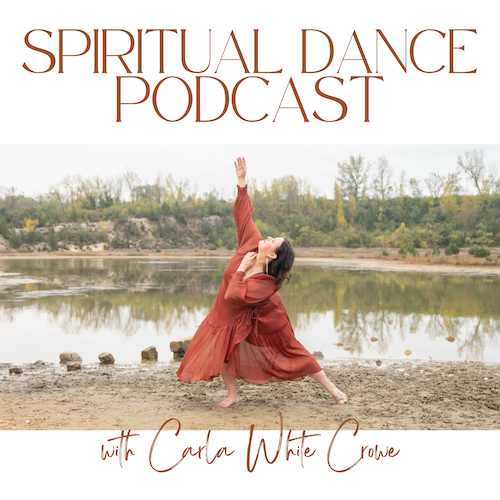 Join the conversation in this haven for creative souls learning how to move in sync with the rhythm of spirit.